Short-Term Comparative Validation of IGS Final Global Ionospheric Map VTEC using Local GNSS Observations over Ogbomoso, Nigeria
Keywords:
GNSS, VTEC, GIM, Low-Latitude IonosphereAbstract
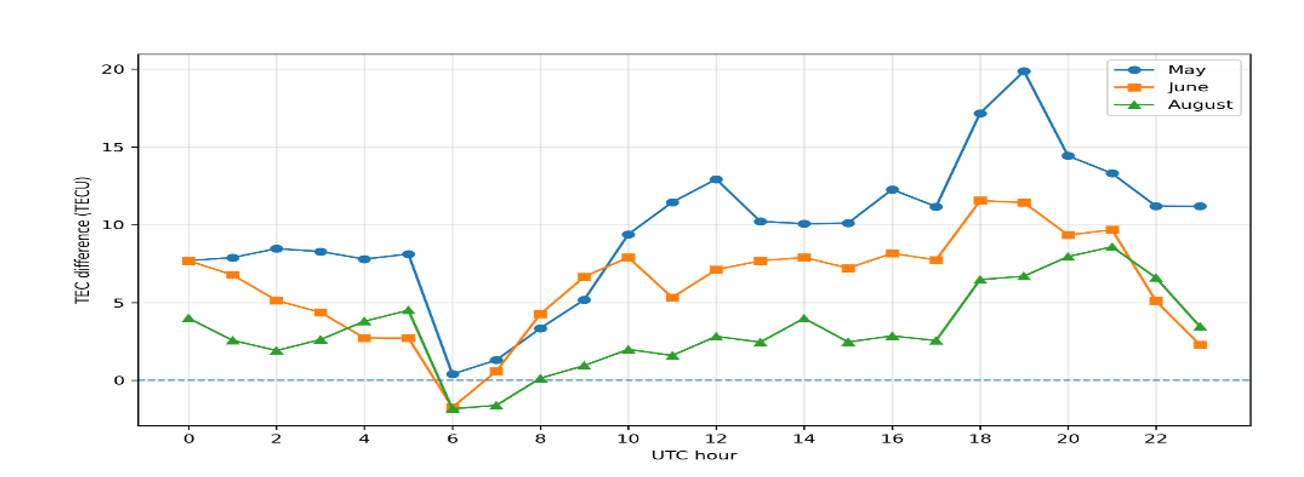
Global Ionospheric Map (GIM) products are widely used for ionospheric research and Global Navigation Satellite System (GNSS) error assessment, but their ability to represent station-specific vertical Total Electron Content (VTEC) variations requires independent local validation. This study evaluates the agreement between station-derived VTEC and the International GNSS Service final GIM VTEC over Ogbomoso, Nigeria (8.1333°N, 4.2500°E). Local observations were obtained from an independently operated dual-frequency GNSS receiver whose data were not used in generating the evaluated GIM, thereby providing an external validation dataset. Corresponding IGS-GIM VTEC values, distributed in IONEX format, were spatially interpolated to the station coordinates and temporally interpolated from two-hourly to hourly resolution. A total of 1,005 matched hourly observations, comprising 333, 336, and 336 pairs from 14 selected observation days in May (1–16 May), June (3–17 June), and August (1–14 August) 2025, respectively, with some days excluded due to data unavailability, were analysed using diurnal and daily variations, scatter analysis, mean bias, mean absolute error, root mean square error, and Pearson correlation coefficient. Strong temporal agreement was obtained, with correlation coefficients of 0.969, 0.958, and 0.971 for May, June, and August, respectively. However, the IGS-GIM generally overestimated station-derived VTEC, with mean biases of 9.66, 6.15, and 3.23 TECU and corresponding RMSE values of 11.15, 7.96, and 5.37 TECU. The closest agreement occurred in August. Although the high correlations indicate strong temporal agreement, the observed biases and RMSE values reveal differences in absolute VTEC magnitude. The local GNSS-derived VTEC estimates are also subject to uncertainties associated with instrumental biases. These findings show that the IGS-GIM reproduced the broad temporal behaviour of VTEC during the selected periods but exhibited month-dependent magnitude differences, highlighting the need for independent local validation before its application to station-specific ionospheric and GNSS studies.
Published
How to Cite
Issue
Section
Copyright (c) 2026 Efua Anthony Ogobor, Gbenro Benjamin Ayantunji, Enoch Oluwaseun Elemo, Adewumi Segun Adebayo, Joshua Olamide Benjamin, Mangete Otonye, Blessing Ochanya Onuh, Hauwa Sani Abdulkadir

This work is licensed under a Creative Commons Attribution-NonCommercial 4.0 International License.